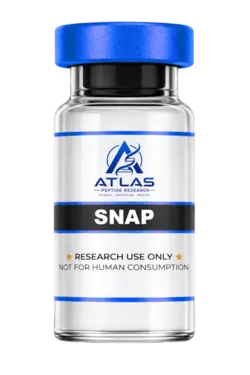
Snap-8
Acetyl Octapeptide-3 (SNAP-25 Fragment Analog)
At a Glance
Molecular Properties
Overview
Compound Description
Snap-8, also known as acetyl octapeptide-3, is a synthetic eight-amino-acid peptide designed to mimic the N-terminal region of the SNAP-25 protein, a critical component of the SNARE complex responsible for neurotransmitter vesicle fusion at the neuromuscular junction. Developed as a next-generation evolution of the hexapeptide argireline (acetyl hexapeptide-3), Snap-8 incorporates two additional amino acid residues for enhanced SNARE complex interaction. The compound has been investigated in cosmetic science as a topical alternative approach to modulating neuromuscular signaling.
Mechanism of Action
Research-Identified Pathways
Snap-8 is designed to competitively interact with the SNARE (Soluble N-ethylmaleimide-sensitive factor Attachment protein REceptor) complex, a protein assembly that mediates the fusion of synaptic vesicles with the presynaptic membrane at neuromuscular junctions. The SNARE complex consists of three proteins: SNAP-25, syntaxin, and VAMP/synaptobrevin.
By mimicking the N-terminal end of SNAP-25, Snap-8 competes with native SNAP-25 for incorporation into the SNARE assembly. This competitive inhibition reduces the efficiency of SNARE complex formation, which in turn attenuates acetylcholine release at the neuromuscular junction. The result is a reduction in the intensity of muscle contractions. In vitro studies have reported modulation of neurotransmitter release in cell-based assays, and topical application studies have investigated changes in skin surface topography associated with dynamic expression patterns.
Key Research Findings
Published Study Highlights
- In vitro studies report competitive inhibition of SNARE complex formation through interaction with the SNAP-25 binding site
- Topical application studies at 10% concentration investigated effects on skin surface topography over 28-day protocols
- Developed as an extended 8-amino-acid evolution of the hexapeptide argireline with enhanced SNARE complex interaction
- LC-MS/MS analytical method development has enabled precise quantification in cosmetic formulations
Areas of Research Interest
Why Researchers Are Investigating This Compound
This compound has attracted significant research attention in the following areas. These represent active fields of scientific inquiry, not validated therapeutic claims. No medical benefits are stated or implied.
- Non-invasive wrinkle research: widely discussed as a topical peptide alternative to injectable approaches for studying neuromuscular modulation in skin
- Expression line research: cosmetic scientists are investigating its effects on dynamic skin surface changes associated with repeated facial movements
- Anti-aging peptide formulation: frequently combined with other cosmetic peptides in multi-target formulation research
Published Research
Peer-Reviewed References
- Jung JH, Kim SY, Lee SJ, et al. "Method development for acetyl octapeptide-3 analysis by liquid chromatography-tandem mass spectrometry." Journal of Analytical Science and Technology (2020). doi:10.1186/s40543-020-00232-8
- Blanes-Mira C, Clemente J, Jodas G, et al. "A synthetic hexapeptide (Argireline) with antiwrinkle activity." International Journal of Cosmetic Science (2002). doi:10.1046/j.1467-2494.2002.00153.x
- Errante F, Ledwoń P, Bhatt TK, et al. "Topical anti-aging peptides: cosmeceutical mechanisms of action and drug delivery systems." Pharmaceuticals (2024). doi:10.3390/ph17010055
Research Use Only
The information presented on this page is compiled from peer-reviewed scientific literature and is provided solely for educational and research purposes. This compound is intended exclusively for laboratory and scientific research use. It is not a drug, pharmaceutical, or dietary supplement. It is not intended to diagnose, treat, cure, or prevent any disease or medical condition. No claims of therapeutic efficacy are made or implied.
Researchers are advised to consult the original published studies referenced above for complete methodological details, study limitations, and the authors' own conclusions. Atlas Peptide Research does not endorse any specific research application and provides this information as a reference resource only.
Interested in Snap-8?
View this compound in our shop to see available sizes, certificates of analysis, and current pricing.
View in Shop